

A digital service supporting more than 400,000 citizens while easing the burden on the public sector

In short
- Services
- Product design
- Industry
- Government
- Capabilities
- Mobile app
- Redesign
- Testing
- User experience
Challenge
Sociálna poisťovňa (Social Insurance Agency) is one of Slovakia's most frequently used public institutions, handling an enormous volume of citizen interactions every day. This naturally puts significant pressure on its customer support and communication channels. One of the most effective ways to ease that pressure is by encouraging more citizens to use digital services.
However, for people to choose digital communication with the government, those services need to be intuitive enough to use independently, without relying on branch staff or call centres. With that vision in mind, we partnered with the Social Insurance Agency to redesign their mobile application.
The biggest challenge was designing a single application for a highly diverse user base. Creating an experience that was equally clear and intuitive for self-employed individuals, employees, employers and senior citizens meant understanding dozens of unique life situations and the specific needs of every user group.
Outcome
In less than two months, we designed a modern, accessible mobile application for more than 400,000 users.
The project demonstrated that government services can be digital, inclusive, fully compliant with legislation, and designed around people's needs and with respect for their time.
Putting ID-SK and Decree 547/2021 into practice
Inclusive design is especially important in public sector projects, where digital services must comply with both national and European standards. When designing the application, we built on two key pillars.
Applying Decree 547/2021 in practice: Decree No. 547/2021 sets strict standards for public sector IT systems, including accessibility requirements based on the Web Content Accessibility Guidelines (WCAG) for people with visual impairments and other disabilities. Accessibility is part of our everyday practice at Lighting Beetle*, so these principles were embedded into the design from the very beginning. As a result, the Social Insurance Agency received a solution fully compliant with legislative requirements.
Ensuring continuity of the ID-SK design system: Lighting Beetle* helped create ID-SK, giving us a deep understanding of its components, principles and design logic. This allowed us to confidently adapt the robust desktop-oriented design system to the specific needs of a mobile experience, including navigation patterns and touch interactions.
Reducing the burden on public services while saving citizens time and reducing costs
Although the project didn't begin with predefined KPIs, user testing confirmed that the solution addressed several key challenges faced by the public sector:
Reducing pressure on branches and call centres: Previously, call centre operators often had to guide citizens step by step through a complex and difficult-to-use website. The new, intuitive application allows users to complete many common tasks by themselves, reducing the workload of already overstretched branch staff.
Encouraging the adoption of digital services: The application combines two previously separate services – the Electronic Insured Person Account (EUP) and the pre-registration – into a single ecosystem. By significantly simplifying these processes, the application encourages even previously reluctant users to communicate with public services digitally.
Improving public service efficiency: By eliminating unnecessary in-person visits, the solution saves valuable time for citizens while simultaneously reducing operational costs for the public sector.
Solution
Over the course of five design sprints, we created a solution that reduces pressure on an overloaded public institution, encourages more citizens to use digital services, and meets strict legislative requirements.
The goal was to transform the existing Electronic Insured Person Account – a web portal that was difficult to use – into a modern mobile application. We translated this complexity into a robust information architecture and carefully designed user flows that guide people directly to the information and actions they need.
With less than two months to take the project from discovery to final design, we replaced the traditional design thinking process with an agile approach centred around rapid prototyping and continuous testing.
Helping people find what they need
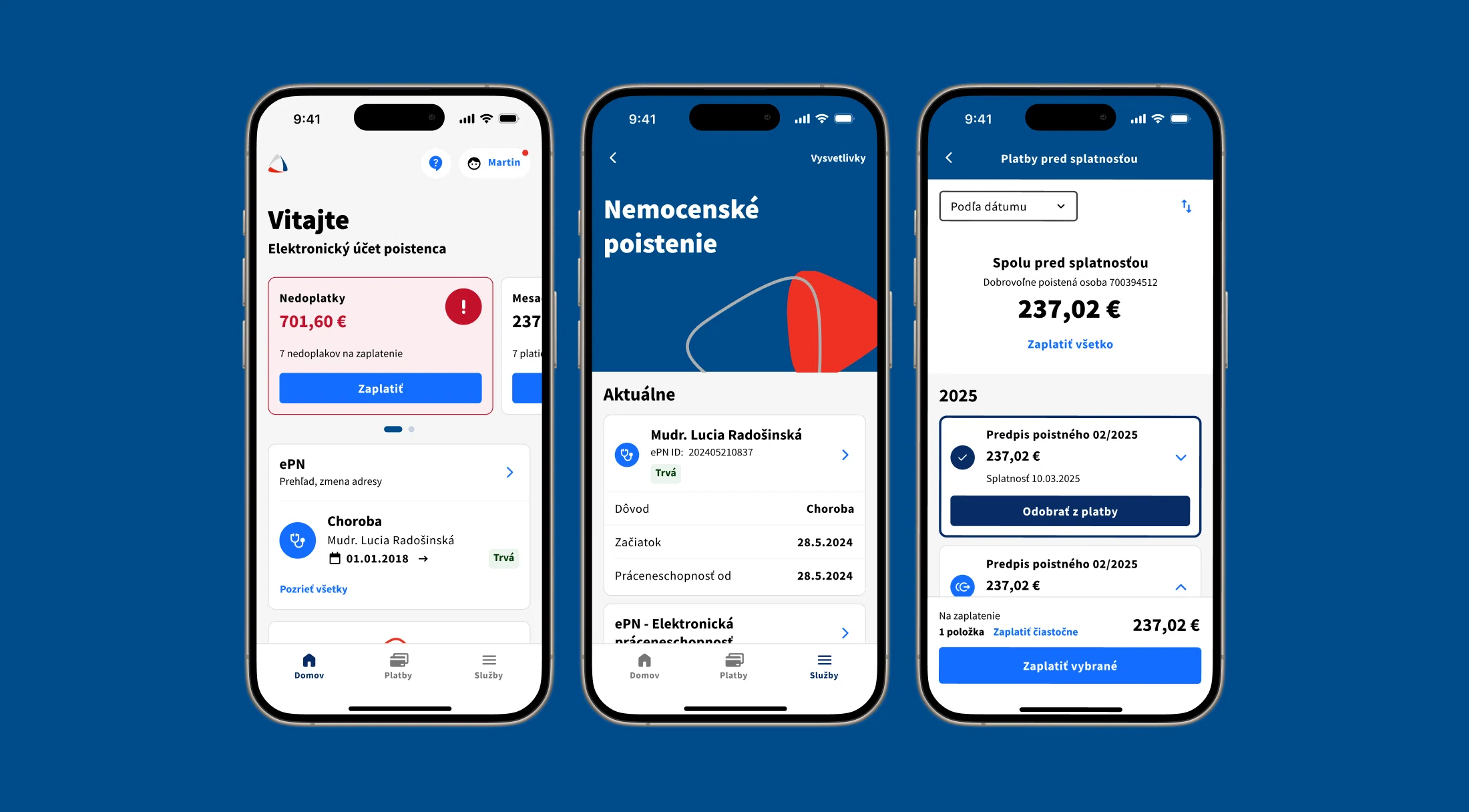
Thanks to the new information architecture, citizens can immediately see what they need to take care of. The redesigned home screen doesn’t force users to understand the complicated organisational structure of the institution. Instead, it guides them through their own life situations using personalised content prioritisation.
Each user group immediately sees the information that is most relevant to them. A self-employed person can quickly check their social insurance contributions, outstanding payments or report sick leave, while employers can easily manage their workforce from the same application.
Guerrilla usability testing in local branches
To validate our key hypothesis – that citizens could navigate the application independently without assistance from the call centre – we tested interactive prototypes directly in Social Insurance Agency branches.
Feedback from real users confirmed that both the navigation and the redesigned home screen were intuitive and easy to understand.
Removing unnecessary bureaucracy
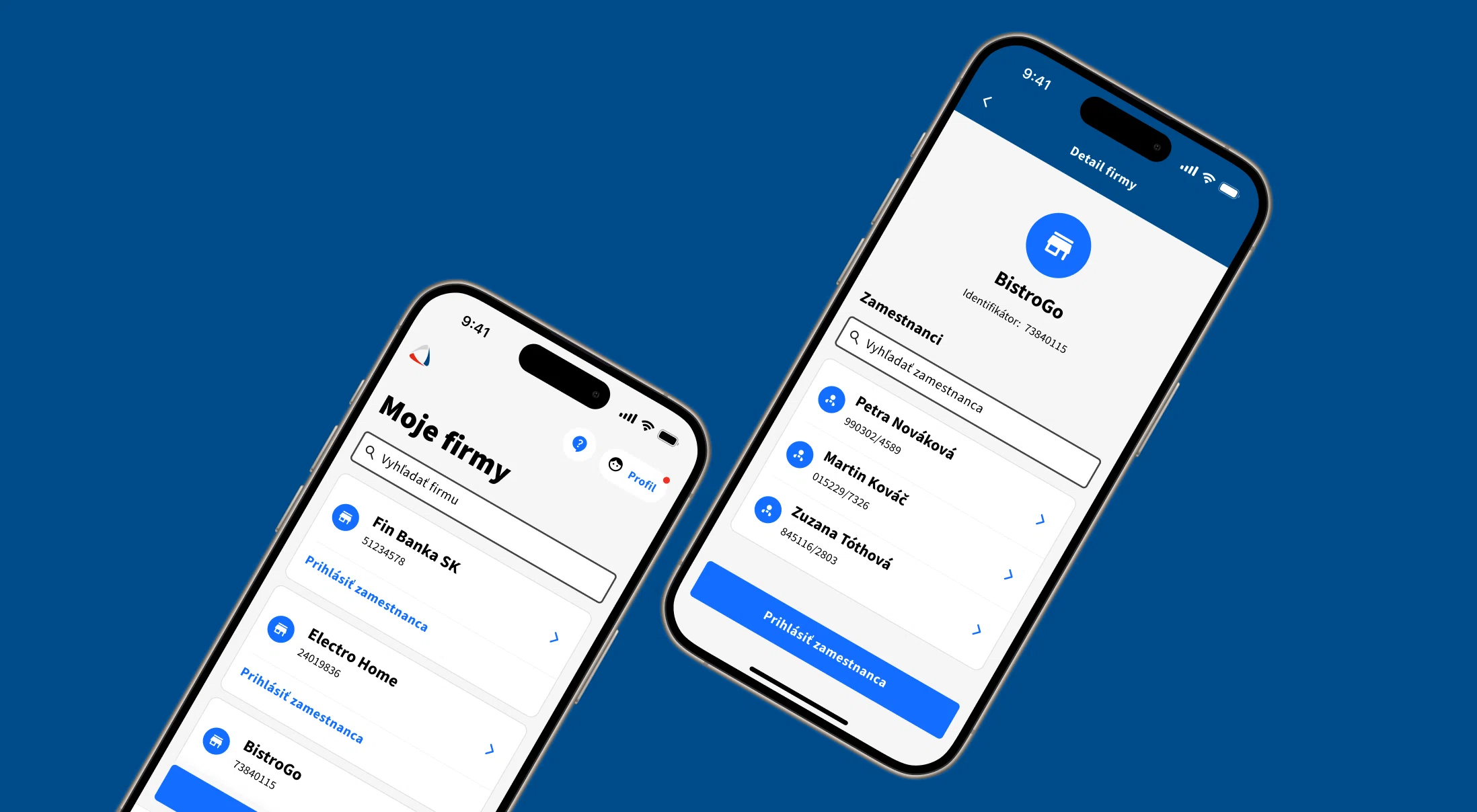
We also integrated the Preliminary Registration module, originally developed under Slovakia's Recovery and Resilience Plan. Instead of maintaining two separate applications, we combined them into a single ecosystem. This brings everything together in one place, making it easy to switch between related services.
This is particularly valuable for employers in high-turnover industries such as hospitality and construction, who often need to quickly register or deregister seasonal employees. They can now do it directly from their phone in just a few taps, without paperwork, phone calls or visits to a local branch.
Putting what matters front and centre
Critical information, such as outstanding payments and important status updates, is brought to the forefront. This allows different user groups to immediately see what requires their attention instead of having to search for it.
For example, self-employed users can settle outstanding payments in just three taps thanks to the integrated payment gateway and Apple Pay. Even more complex services, such as tracking electronic sick leave (ePN) or checking the status of a pension application, have been simplified for users to manage them confidently without instructions or additional support.
Want to know more?
Let's connect
Get in touch to learn more about this project and how we can help with a similar challenge.
Get in touch
